
Market Entry into China?A Digital Marketing Analysis
Analysis of the Size of China's New Media Industry
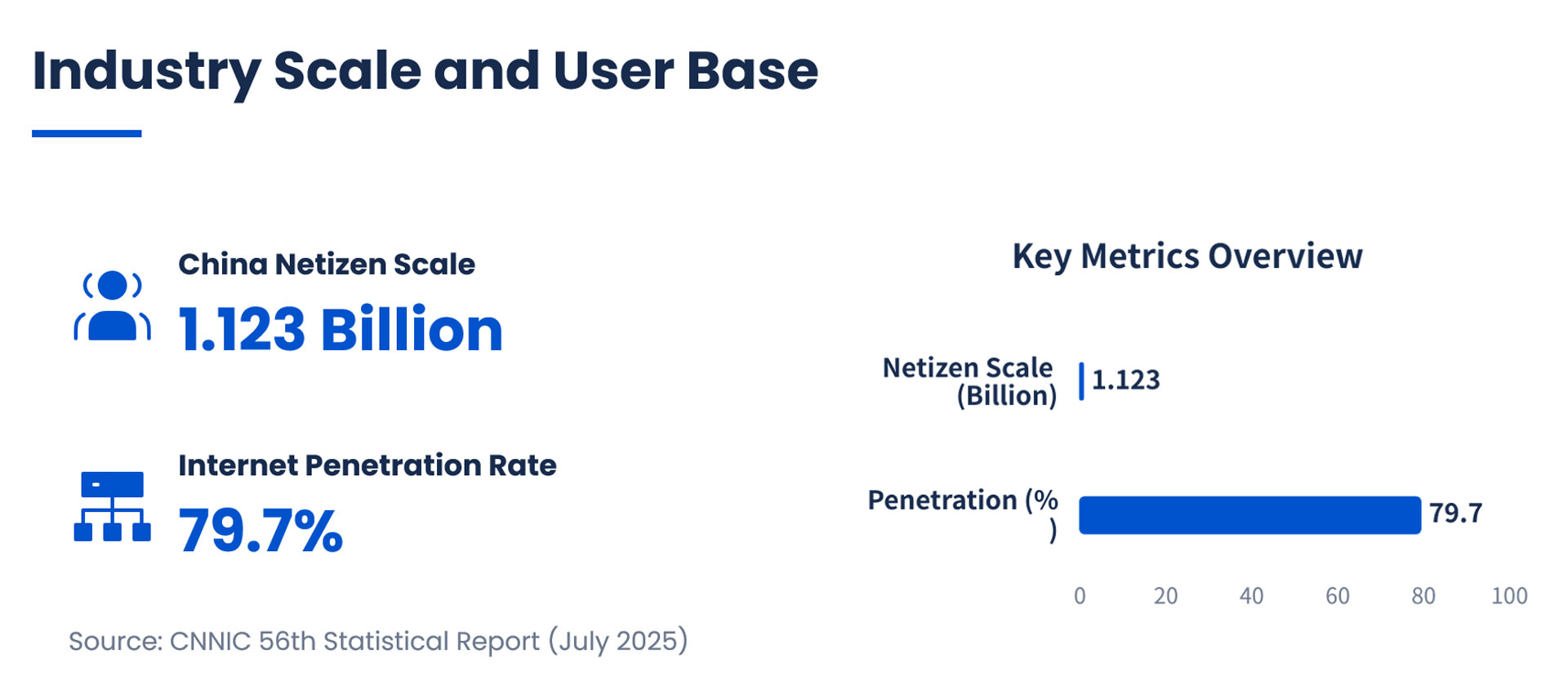
China's digital marketing sector has continued to expand in recent years. Benefiting from the rapid development of the Chinese internet, the number of new media users has continued to grow. According to the 56th Statistical Report on Internet Development in China released by the China Internet Network Information Center in July 2025, as of June 2025, the number of Chinese internet users had grown to 1.123 billion, with an internet penetration rate of 79.7%.
Analysis of the Supply Structure of China's New Media Industry
In China's digital marketing ecosystem , the clustering effect of leading platforms is significant. The distribution of Chinese new media companies is mainly concentrated in first-tier cities, such as Beijing (ByteDance, Baidu, Sina), Shanghai (Bilibili, Xiaohongshu), Shenzhen (Tencent), and Hangzhou (Alibaba), forming core industrial belts dominated by leading platforms. Meanwhile, Chengdu, Chongqing, Changsha, Guangzhou and other places have become secondary centers by relying on localized content or the transformation of traditional media.
The leading platform exhibits a significant clustering effect:
• In the short video and live streaming sector : Douyin and Kuaishou have formed a duopoly.
• Social media and information aggregation : The market is dominated by platforms such as Weibo, Xiaohongshu, Bilibili, and Toutiao.
• Vertically segmented market : Such as knowledge payment, e-commerce, new media, and enterprise services, present a diversified competitive landscape.
Demand-side Analysis of China's New Media Industry
China's digital marketing industry is mainly concentrated in sub-sectors such as online video, short video, search engines, live streaming, and online literature.
According to a report released in March 2025 by the China Internet Network Information Center (CNNIC) and the China Netcasting Services Association:
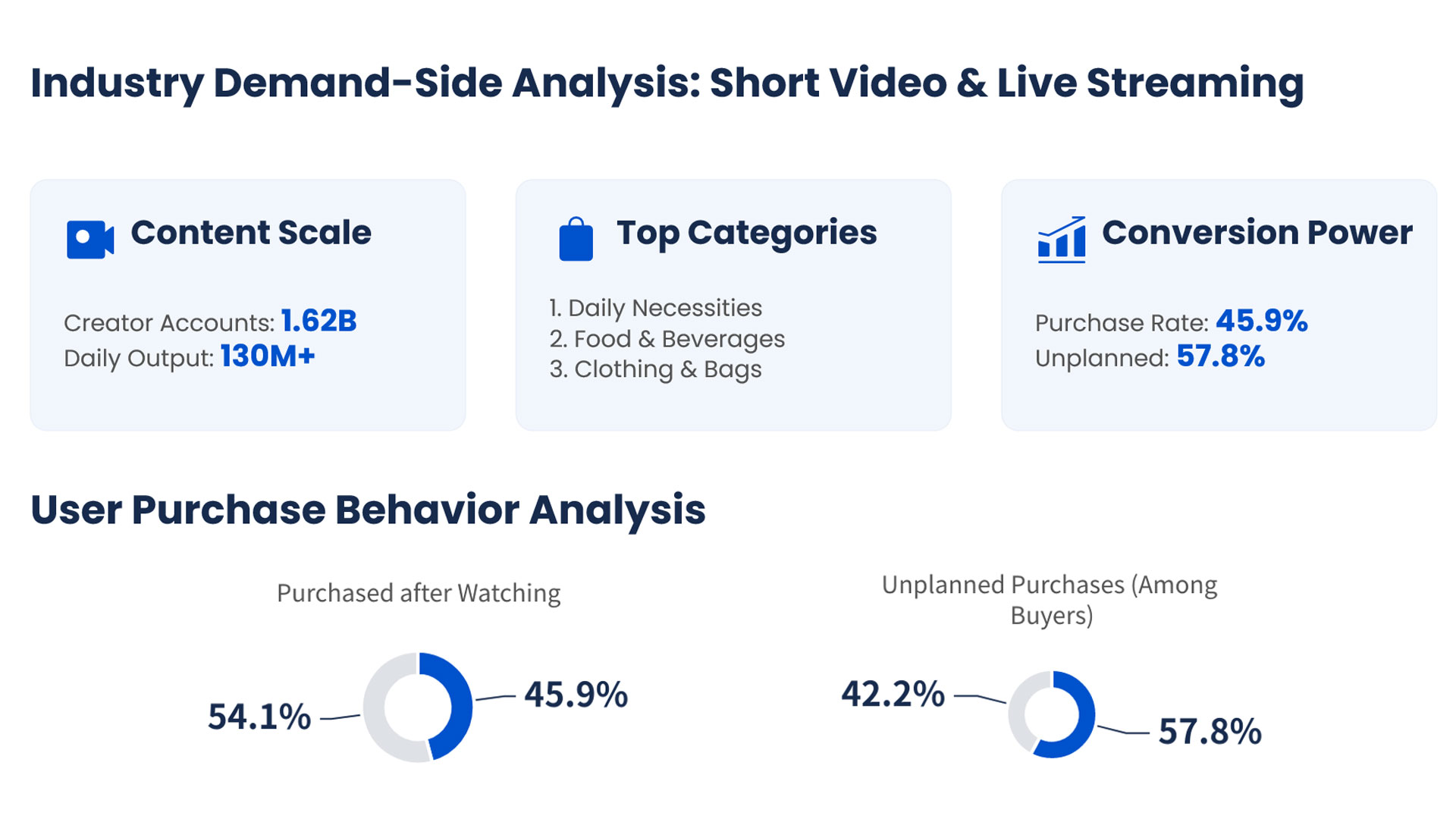
• The number of short video creator accounts in China has reached 1.62 billion, with an average daily content output exceeding 130 million pieces.
• 45.9 % of users purchased goods after watching short videos and live streams, of which 57.8% of the purchases were unplanned consumption.
• Daily necessities, food and beverages, clothing and bags are the top three categories of purchases.
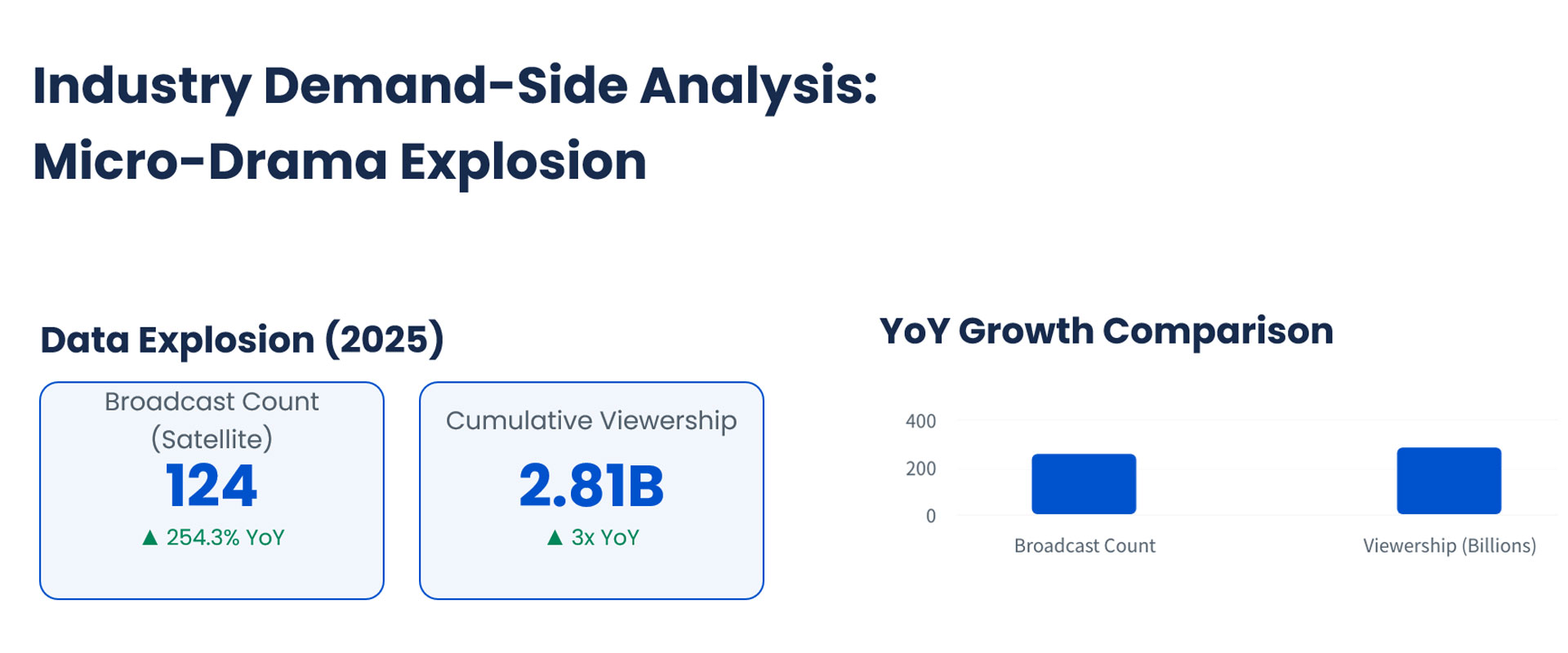
Furthermore, since 2025, the State Administration of Radio and Television has vigorously promoted the creation of high-quality micro-dramas. According to statistics, the number of micro-dramas broadcast on satellite TV channels saw significant growth throughout 2025, reaching a total of 124, a 254.3% increase compared to the same period last year. The cumulative viewership reached 2.81 billion, more than three times that of the same period last year. Among them, 65 micro-dramas surpassed 10 million viewers, accounting for 52.4% of the total number of micro-dramas broadcast.
Analysis of Changes in Demand Structure in China's New Media Industry
With the popularization of digital technology and changes in user habits, the demand structure of China's digital marketing industry is undergoing reshaping.
In terms of user demand, the shift from passive reception to active participation and interaction has given rise to fragmented and interactive content formats such as short dramas and animated comics. In terms of business demand, the focus has shifted from pursuing traffic coverage to achieving a unified brand, performance, and sales strategy, driving omnichannel marketing and instant retail as growth engines. In terms of technological demand, AI-generated content has fully permeated the content production process, driving the industry's transformation from a labor-intensive model to a human-machine collaborative model. In terms of talent demand, there is a growing trend towards a combination of front-line performance roles and back-office operational support roles.
Overall, China's digital marketing industry is transitioning from a phase of extensive expansion to a new stage of development centered on data-driven, technology-enabled, and refined operations across the entire value chain.
Analysis of the Internal Competitive Landscape of China's New Media Industry
China's new media market is characterized by a competitive landscape where "traffic is concentrated in the hands of giants, while traditional media are transforming to survive." Internet platforms dominate the market due to their technological advantages, while traditional media are accelerating their digital transformation, and the entire industry is undergoing structural adjustments.
A duopoly structure :
• ByteDance : With the recommendation algorithm and massive user-generated content of "Douyin" and the information aggregation capabilities of "Toutiao", it firmly occupies the high ground of traffic in short videos and information flow ads.
• Tencent : Centered on the super social platform "WeChat", it has built an unparalleled user relationship chain and private traffic pool, and continues to invest in the long-form video field through "Tencent Video".
the long-form video sector, a three-way competitive landscape has emerged: Driven by capital and intellectual property, the competitive landscape among iQiyi, Tencent Video, and Youku is relatively stable, but all three are currently facing profitability challenges. Industry competition has shifted from simply vying for user scale to long-term investment in high-quality copyrighted content and self-production capabilities, as well as achieving sustainable operation through price increases and cost structure optimization.
客户留言
First Name*
Last Name*
E-mail*
WhatsApp
Line
WeChat
Country*
Website / Company Name*
What projects are you interested in? (Multiple options available)*
- E-commerce
- Social Media
- SEO
- Video Production
- Advertising
- Website Design
- Influencer Marketing
- Press Release Distribution
- Brand Identity Design
- Rebranding Solutions
- Campaign Activation
- Chinese Wikipedia Writing
- Company Registration
- Accounting & Tax Filing
- Trademark|Patent|Copyright
- Shop Design & Decoration
- Other Services
Annual Marketing Budget(USD)*
- <$10,000
- $10,000 - $50,000
- $50,000 - $300,000
- $300,000 - $1,000,000
- $1,000,000 - $5,000,000
- >$5,000,000
Please briefly describe your needs.
- I have read and agree with 《Privacy Policy》
Brandoro


;)
;)
;)